serving rural america
“A man’s pride can be his downfall, and he needs to learn when to turn to others for support and guidance.” – Bear Grylls
Information and Services for Moving Forward
Rural Minds™ recognizes and respects the work that has been done to establish mental health resources by many organizations listed on the following links:
Find suicide hotlines and organizations that provide mental health crisis information here.
Find organizations that provide mental health information and services here.
THE SILENT EPIDEMIC RAVAGING RURAL AMERICA
Rural Americans are known for having a solid work ethic and will power. They aim to meet every challenge with the determination to overcome and persevere. But mental illness can affect a person’s ability to meet life’s challenges and mental illness is one fight that rural America is losing. Compared with their urban counterparts, rural Americans have a higher rate of depression (1); and suicide rates of people living in rural counties are 64-68% higher than those living in urban areas. (2).
Stress factors unique to rural life include a weakening agricultural economy, financial instability, and a solitary lifestyle.
A SURVEY SHOWED THAT HIGH LEVELS OF DISTRESS IN RURAL COMMUNITIES ROSE FROM 17 PERCENT IN APRIL 2020 TO 28 PERCENT IN JANUARY 2021 DUE IN PART TO THE CORONAVIRUS PANDEMIC
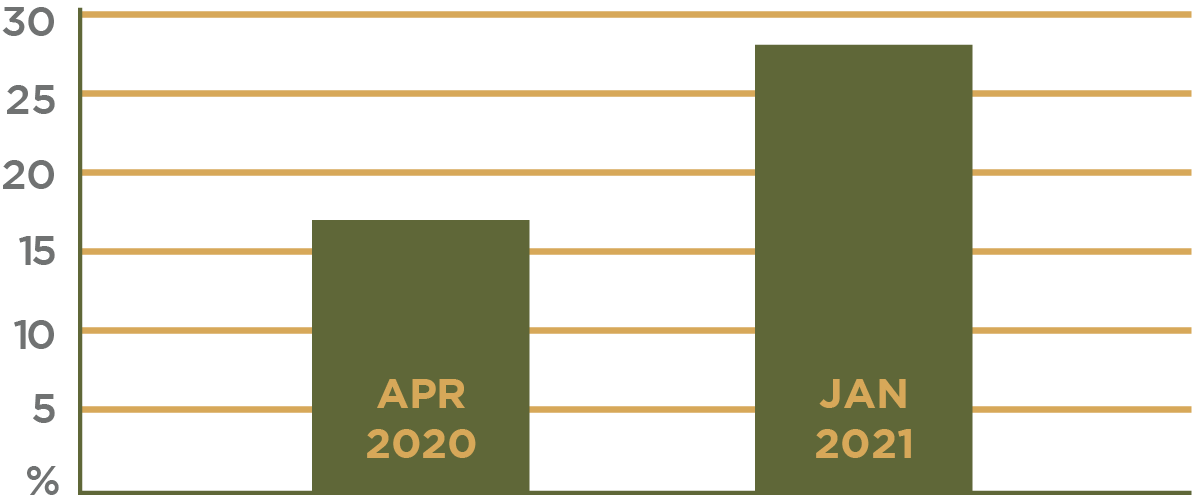
National Center for Health Statistics, “Household Pulse Survey: Anxiety and depression,” Centers for Disease Control and Prevention, accessed January 2021, cdc.gov.
While about one in five adults in the U.S. suffers from a diagnosable mental disorder in a given year (3), mental illness is a bigger challenge in rural America due to unique barriers:
RURAL AREAS HAVE 20 PERCENT FEWER PRIMARY CARE PROVIDERS THAN URBAN AREAS

Source: JAMA, Assessment of Changes in Rural and Urban Primary Care Workforce in the United States From 2009 to 2017, Original Investigation Health Policy, October 28, 2020; Donglan Zhang, PhD1; Heejung Son, MS1,2; Ye Shen, PhD2; et al
65 PERCENT OF RURAL COUNTIES DO NOT HAVE A PSYCHIATRIST

Source: Andrilla CHA, Patterson DG, Garberson LA, Coulthard C, Larson EH. Geographic Variation in the Supply of Selected Behavioral Health Providers. Am J Prev Med. 2018 Jun;54(6 Suppl 3):S199-S207. doi: 10.1016/j.amepre.2018.01.004. PMID: 29779543
81 PERCENT OF RURAL COUNTIES DO NOT HAVE A PSYCHIATRIC NURSE PRACTITIONER

Source: Andrilla CHA, Patterson DG, Garberson LA, Coulthard C, Larson EH. Geographic Variation in the Supply of Selected Behavioral Health Providers. Am J Prev Med. 2018 Jun;54(6 Suppl 3):S199-S207. doi: 10.1016/j.amepre.2018.01.004. PMID: 29779543
95 Percent of Rural Counties Do Not Have A Child Psychiatrist

Source: Mental Health, United States. DHHS Pub. No. (SMA) 99-3285. Washington, DC: Superintendent of Documents, U.S. Government Printing Office, 1998, 204-213
28 percent of rural homes lack access to broadband
Source: Vogels, E. (August 19, 2021). Some digital divides persist between rural, urban and suburban America. Pew Research Center. Retrieved from, https://www.pewresearch.org/fact-tank/2021/08/19/some-digital-divides-persist-between-rural-urban-and-suburban-america/1
RURAL LIFESTYLE CHALLENGES TO MENTAL HEALTH INCLUDE:
Self-imposed barrier of asking for help when taught to pursue self-reliance as a virtue
Lack of trust in anyone to maintain confidentiality in a small, close-knit community
Fear of negative judgement from others as being incompetent or less capable
Difficulty getting an appointment with limited availability of mental health professionals
Time and transportation required for long-distance travel to meet with a mental health professional
Unreliable, expensive or nonexistent internet service for online video or telehealth appointments
Lack of adequate health insurance coverage
Feeling of isolation without having access to talk with someone outside of the community who understands mental health challenges in rural America
Tragically, due to insufficient services for those most in need, the mental health crisis responder for most rural Americans is a law enforcement officer (4).
Sources: 1 Capriotti T, Pearson T, Dufour L. (2020, February 18). Health Disparities in Rural America: Current Challenges and Future Solutions. Clinical Advisor. Retrieved from https://www.clinicaladvisor.com/home/topics/practice-management-information-center/health-disparities-in-rural-america-current-challenges-and-future-solutions/
2 Centers for Disease Control and Prevention. (2022). Disparities in Suicide. Retrieved from https://www.cdc.gov/suicide/facts/disparities-in-suicide.html
3 National Institute of Mental Health, 2019 data courtesy of SAMHSA. Retrieved from https://www.nimh.nih.gov/health/statistics/mental-illness
4 National Institute of Mental Health, Mental Health and Rural America: Challenges and Opportunities, May 30, 2018. Retrieved from https://www.nimh.nih.gov/news/media/2018/mental-health-and-rural-america-challenges-and-opportunities
Rural Minds™ serves the mental health needs of rural Americans by:
Listening to and providing a forum for courageous people to share their experiences with mental illness;
Connecting rural Americans across the country with existing mental health resources including crisis and suicide hotlines, via www.RuralMinds.org;
Identifying gaps in mental health information and services;
Partnering with community leaders and organizations on mental health initiatives;
Collaborating with individuals and organizations to improve rural mental health including rural residents, donors and volunteers, large and small nonprofits, and socially responsible corporations with a strong interest in the health of rural Americans, and;
Developing new educational resources and support services to address the unmet needs for mental health in rural communities throughout the United States.

Future Initiatives
TO IMPROVE MENTAL HEALTH IN RURAL AMERICA, THERE ARE CHALLENGES THAT ARE UNIQUE TO THE RURAL LIFESTYLE THAT NEED TO BE OVERCOME, INCLUDING:
Many people living in rural communities find it difficult to ask for help
There’s a shortage of mental healthcare providers in rural communities
Rural Minds aims to empower people living in rural communities with the information and resources they need to become part of the solution. This involves partnering with other organizations to create mental health educational content and training programs that honor self-reliance in rural Americans.
By serving as trusted sources of information and having courageous conversations about mental health, we believe rural Americans can help each other overcome many mental health challenges and minimize the stigma that surrounds mental illness.
Rural Mental Health Connections Webinar
Watch video of Previous Webinars